Why Round Numbers Still Matter in an Algorithm-Driven Market
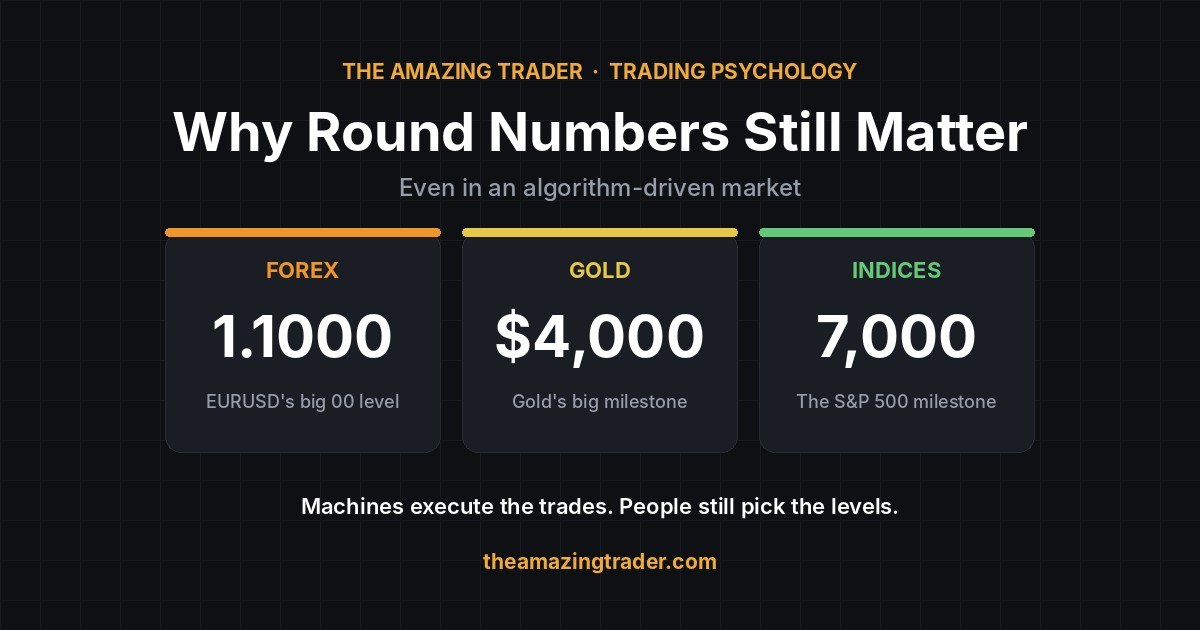
Machines now do most of the trading. Yet round numbers still pull price like magnets. EURUSD at 1.1000, gold at $4,000 and the S&P 500 at 7,000 all draw a crowd. So why do round numbers matter when algorithms run the show?
The short answer is people. Algorithms handle the execution. However, humans still decide where many of the orders sit.
Not all round numbers are equal
Some price endings get far more attention than others. Levels ending in 00 carry the most weight. Next come levels ending in 50. Below those, many traders also watch levels ending in 20 and 80.
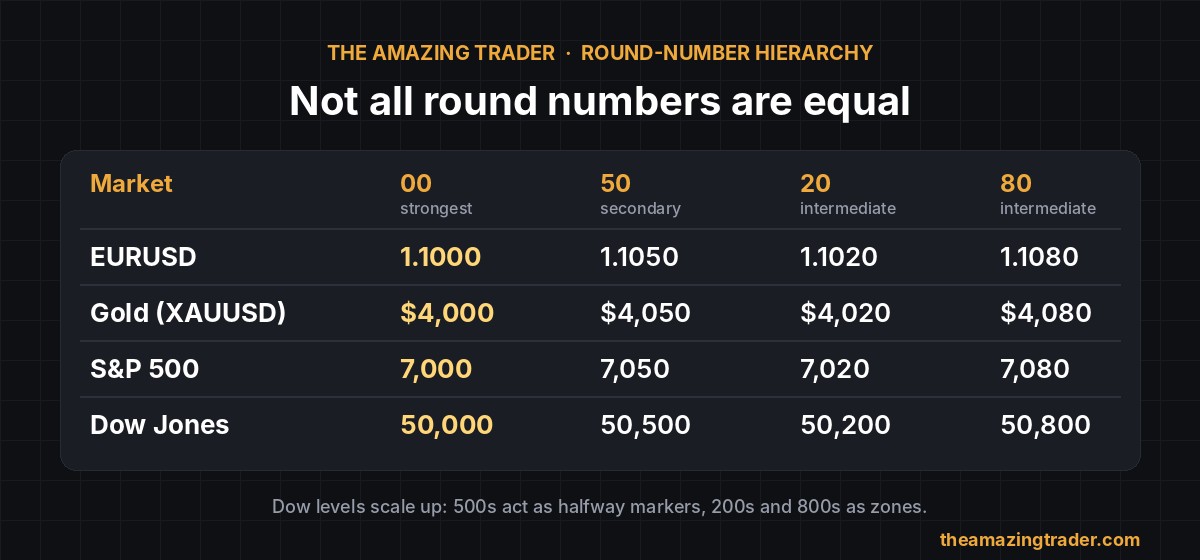
These levels are easy reference points. Traders use them to enter, take profit, place stops or plan for a breakout. A price ending in 00 simply gets noticed more than one ending in 17 or 43, even though both are just numbers. We covered the halfway level in detail in the power of the 50 level.
Why forex shows round numbers most clearly
EURUSD 1.10: Repeated failures to establish above was followed by a sharp move to the downside

Forex is the clearest example. Stocks trade on exchanges and other venues. Spot forex, on the other hand, has no central exchange. Instead, pairs like EURUSD, GBPUSD and USDJPY are quoted across a huge network of banks, brokers and electronic platforms. It’s also the biggest market of all, as the BIS turnover survey shows.
Brokers can show slightly different prices. Still, everyone follows the same underlying spot rate. A trader in London watching EURUSD approach 1.1000 sees the same broad level as a trader in New York or Tokyo.
That shared reference makes big levels visible worldwide. Of course, it doesn’t mean everyone gets the same fill or sees the same order book. It just means the same levels shape decisions in many places at once.
Gold and its big milestones
XAUUSD 3500: : Failure to hold below led to a sharp bounce back above (Nov 23, 2026)

Gold is one of the best examples outside forex. When gold (XAUUSD) nears a milestone like $4,000 an ounce, everyone notices. Central banks, funds, futures traders, the media and retail investors all watch it.
A move through $4,000 can pull in momentum traders. Meanwhile, investors who bought lower may see the same level as a place to take profit. Stop orders add to the action, too. The same thing can happen at $3,800, $3,850 or any other well-known level.
Keep one detail in mind. Spot gold and gold futures are related but not identical. Futures can trade at a different price because of financing, storage and contract terms. Even so, the big round numbers get watched in both markets.
Stock indices and round-number milestones
US500 7000: Failure to hold below led to a sharp bounce back above (Nov 23, 2026)

Indices work the same way. When the S&P 500 nears 7,000 or the Dow nears 50,000, those readings become headlines. Investors and the media follow them closely. Traders, in turn, use them for targets, momentum checks and support or resistance.
The same goes for the Nasdaq 100. Futures traders, cash investors and options desks don’t all work from the same price. Nevertheless, the big milestones still shape what the market expects. Indices also move at different speeds, as we explained in why stock indices move at different speeds.
Why algorithms haven’t killed round numbers
This is the key question. Algorithms have no emotions. They don’t get excited when EURUSD hits 1.1000 or the Dow hits 50,000.
But algorithms are built to find liquidity, read order flow and fill trades efficiently. Meanwhile, traders keep placing limit orders, stops and targets around obvious levels. Big desks also use reference prices when they work large orders. As a result, algorithms react to the orders that pile up there.
In other words, machines don’t care about round numbers themselves. They care about the trading that builds up around them. That’s where human psychology and automated trading meet.
Liquidity, stops and sudden moves
Picture gold climbing toward $4,000 an ounce. Several things can happen at once:
- Traders who are long may take profit near $4,000.
- Short sellers may open new positions at the level.
- Breakout traders may place buy stops just above it.
- Traders who are short may put protective stops above it.
- Others may position for a reversal.
If gold breaks through decisively, those triggered orders can speed up the move. That’s why markets often see sudden bursts of volatility around big levels. We explain how stops get hunted in stop loss orders in forex trading.
However, you can’t always see where the orders sit. Spot forex and OTC gold are fragmented. Futures and stocks, by contrast, show more of the order book.
When round numbers turn into support or resistance
Round numbers don’t become support or resistance automatically. What matters is how the market reacts when price gets there.
For example, if the S&P 500 fails at 7,000 again and again, sellers gain confidence there. On the other hand, if it breaks above 7,000 and holds on a pullback, old resistance can become support. A strong breakout can also trigger more buying as momentum traders jump in and stops get hit.
So tell a real breakout from a brief poke above the level. Look at price action, volume, momentum and volatility, not the number alone. Starting from the bigger timeframe helps, as we show in drill down trading.
Why 00 and 50 beat 20 and 80
All four endings can be useful. Even so, they don’t carry equal weight. Levels ending in 00 are the clearest milestones. Levels ending in 50 are the main halfway markers between them.
The 20 and 80 levels can matter too. Traders often use them to mark zones on the way to the next big number. Still, this order isn’t a law. It changes with the instrument, the price scale, market conditions and your strategy.
The bottom line
Algorithms have changed how trading works. They haven’t changed human behavior. Round numbers are still shared reference points for retail traders, banks, funds and trading systems alike.
Forex shows it most clearly. Gold shows how milestones grab global attention. Indices show how levels become focal points for investors and the media. Ultimately, the machines may place the trades, but people still decide where many orders go.
Technology decides how trades get done. Psychology still explains where traders choose to trade. Our Daily Tips flag the key round numbers on EURUSD, gold and the indices every day.
Want to see trend, momentum and key levels on one chart? See what The Amazing Trader can do.

About author