Price Isn’t Purpose: What Bitcoin, Stablecoins and Ether Are Really Used For
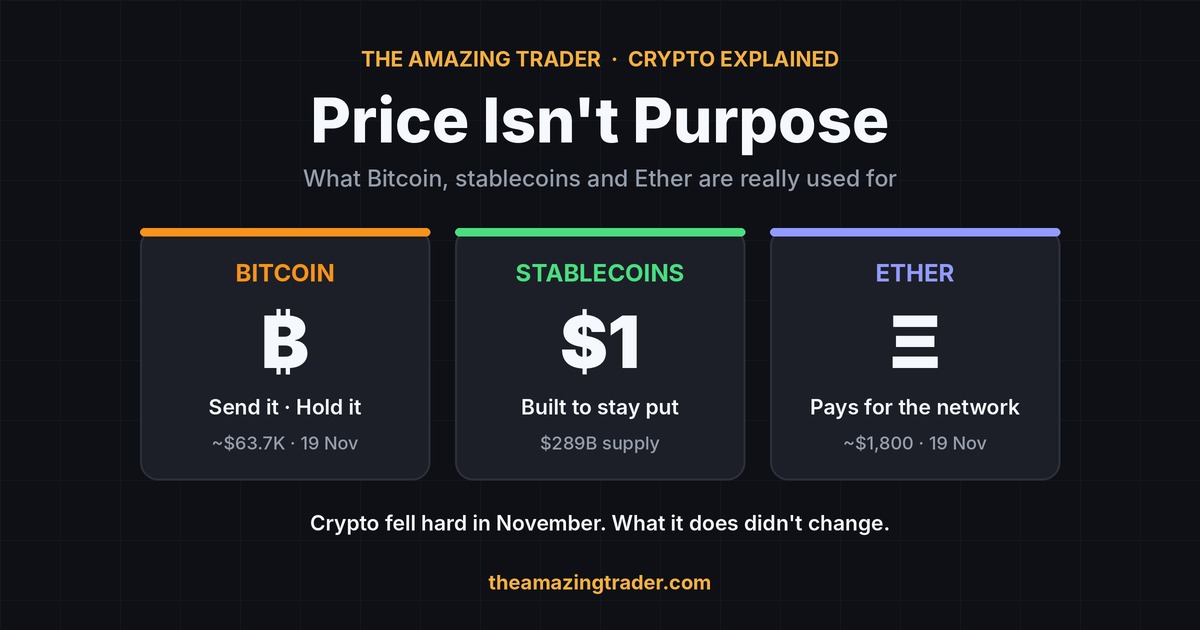
Bitcoin traded near $63,700 on 19 November, roughly 30% lower than a year earlier. Ether sat close to $1,800. Yet nothing about how either coin works changed during that slide. That’s the point most traders miss. Cryptocurrency uses and crypto prices are two separate stories.
So before you trade any coin, ask two questions. What does it actually do? And what is driving demand for it right now?
Cryptocurrency uses: one label, many jobs
“Crypto” sounds like one market. In reality, it’s a family of very different tools, which is why cryptocurrency uses vary so much. All of them live on networks that usually run on a blockchain, a shared record of every transaction. When you send a coin, the network checks the transfer and writes it into that record.
You can keep coins at an exchange or in your own wallet. With a self-custody wallet, you hold the keys that approve each transaction. That gives you full control. However, it also makes you fully responsible. Lose the keys or send to the wrong address, and nobody can reverse it.
Bitcoin: send it, hold it, trade it
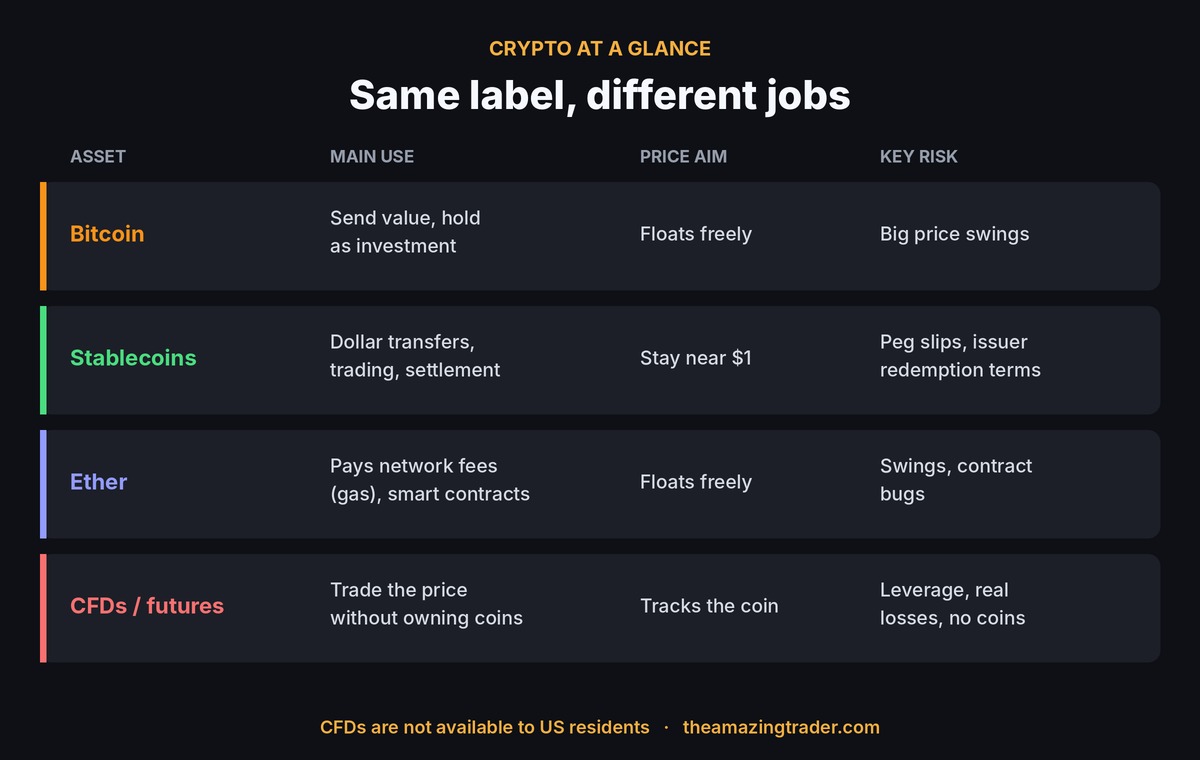
Sending money. Bitcoin lets you send value straight to someone’s address with no bank in the middle. The network never closes, so weekends and holidays don’t matter.
Still, look at the other end of the transfer. If your recipient needs local cash, they must convert the coins first. Network fees, exchange fees and price swings all eat into what arrives. For a cross-border payment, therefore, the only number that counts is the total cost from your currency to theirs.
Holding it as an investment. Bitcoin’s code caps supply at 21 million coins. Many buyers see that scarcity as a reason it could hold value, hence the “digital gold” nickname. But that’s an investment thesis, not a guarantee. A fixed supply can’t create demand. This November proved it, with Bitcoin down for weeks in a row.
Paying for things. Some merchants accept Bitcoin, often through a processor that turns it into dollars on the spot. If you already own coins, that can be handy. On the other hand, buying Bitcoin just to pay with it adds fees and steps. A card is usually simpler.
Volatility is the real problem for shops. If the price moves 5% or 10% in a day, a price tag in Bitcoin can quickly be wrong. That’s why most merchants keep prices in dollars. It also explains why Bitcoin hasn’t taken over everyday shopping.
Stablecoins: built to stay put
Stablecoins such as USDT and USDC aim to track the US dollar. As a result, you can move a dollar amount without riding Bitcoin’s swings along the way. Total supply stood near $289 billion in mid-November, so these coins are far from a niche.
Traders use them as a parking spot. For example, you sell Bitcoin for USDC, wait, and later buy another coin with it. Businesses also use stablecoins to settle cross-border payments, as long as both sides can receive and convert them.
Remember, though, the $1 peg is a goal, not a promise. A stablecoin can slip below its target. Moreover, whether you can redeem it for real dollars depends on the issuer’s terms and the services open to you.
Ether: the fuel that runs Ethereum
Ethereum is the network. Ether (ETH) is the coin that pays its fees, known as gas. Say you send USDC over Ethereum. The USDC goes to your recipient, but you pay the fee separately in ETH.
Much of the activity comes from smart contracts. These are programs that run a transaction automatically once set conditions are met. A decentralized exchange uses them to swap tokens. Similarly, lending apps use them to manage loans and collateral. Of course, all this depends on the code working. One bug in a smart contract can put money at risk.
Trading the price without owning a coin
There is one more way to use crypto: trade its price only. Outside the US, many brokers offer crypto CFDs (contracts for difference). Your profit or loss depends on how far the price moves between opening and closing the trade. US residents can’t trade CFDs. Instead, they can use regulated products such as CME Bitcoin futures.
Either way, you own no coins. You can’t send them, spend them or move them to a wallet. And if you need ETH to pay gas on Ethereum, a contract won’t help. No coin changes hands, but the gains and losses are very real. With leverage, they arrive fast. That’s why our 10 rules of risk management apply here more than anywhere.
Cryptocurrency uses don’t set the price
Here’s the trap. Cryptocurrency uses tell you what a coin is for, not what it’s worth. A coin can be genuinely useful and still be a poor trade at today’s price. A stablecoin is useful exactly because it doesn’t move. A blockchain can get busier while its token falls. Likewise, Bitcoin can rally or crash while the way people use it barely changes.
In other words, usefulness explains what you’re buying. Demand explains why the price moves. And demand comes from money flows, interest rates, risk appetite and positioning. It’s the same supply and demand story that drives every other market.
Putting cryptocurrency uses to work in your trading
- Know the job first. Is it money, a dollar substitute, or network fuel? That tells you what can and can’t move it.
- Then find the driver. Check what is pushing demand this week, not what the coin promises in five years.
- Let the chart decide timing. Start on the big picture and work down, as we do in drill down trading.
The bottom line
Price isn’t purpose. Bitcoin moves value and attracts investors. Stablecoins move dollars. Ether keeps Ethereum running. Each of these cryptocurrency uses is real, yet none of them can tell you where the price goes tomorrow.
So understand the coin, then trade the demand. It’s one more piece of the trading puzzle. Our Daily Tips follow Bitcoin and the big markets every day.
Want trend and momentum on one chart, crypto included? See what The Amazing Trader can do.


About author