The Power of the Hard Trade: Why the Toughest Trades Often Lead to Trading Success
Why the Toughest Trades Often Lead to Trading Success
Hard Trade
One of the greatest lessons every successful trader eventually learns is that the hardest trade to take is often the right one.
It sounds simple enough, yet putting this lesson into practice is one of the biggest challenges in trading. When markets are moving quickly and emotions are running high, most traders naturally gravitate toward trades that feel comfortable. Unfortunately, comfortable trades are often the ones with the lowest probability of success.
Professional traders understand something that beginners often discover the hard way: the market rewards discipline, patience, and the willingness to make uncomfortable decisions. The best trading opportunities rarely feel obvious or easy. Instead, they usually require the confidence to follow market momentum, trust your trading plan, and ignore emotional impulses.
If you want to become a consistently profitable trader, learning how to recognize and embrace the “hard trade” may be one of the most valuable skills you ever develop.
Hard Trade
Why Easy Trades Are Often the Wrong Trades
Human nature constantly works against successful trading.
Everyone wants to buy at the lowest possible price and sell at the highest possible price (“buy low, sell high”). On paper, this sounds logical. In reality, it often encourages traders to fight strong market trends instead of trading with them.
Imagine watching EURUSD suddenly rally 40 or 50 pips after a major economic announcement. The immediate thought for many traders is:
“It has already moved too far. It has to come back.”
The temptation is to sell into strength or buy into weakness simply because prices appear stretched.
The problem is that markets can remain overbought or oversold much longer than most traders expect. Strong trends are fueled by institutional money, algo trading, central bank expectations, and shifts in market sentiment. Trying to stand in front of that momentum can quickly become an expensive lesson. Remember, it is better to be a trader than a liquidity provider.
These “easy” trades feel attractive because they promise excellent entry prices and tight stop losses. Unfortunately, they often place traders on the wrong side of the dominant trend.
NZDUSD 30 minute chart (can be applied to any market)

The farther the move from the low, the “harder” it is to find a good entry with a “good” stop, even though the “hard” trade (i.e. buy) is the “right” trade.
Trading Psychology: Why Our Brains Make Poor Trading Decisions
The financial markets constantly expose the weaknesses of human psychology.
After taking profits on a winning short position, a trader may watch the market continue another 75 pips lower. Instead of selling again, the trader hesitates.
Selling now feels uncomfortable because the price appears “too low.”
Buying the first bounce suddenly feels much safer.
Unfortunately, that feeling is usually driven by emotion rather than probability.
Successful trading requires making decisions based on what the market is actually doing, not what feels emotionally comfortable.
While these instincts may help in everyday life, they often become liabilities in financial markets.
Professional traders learn to recognize these emotional biases without allowing them to dictate trading decisions. We cover this in more depth in The Market Isn’t Your Enemy.
The Hidden Problem With Stop-Loss Placement
One of the biggest reasons traders avoid the hard trade is because of stop-loss placement.
As trends accelerate, logical technical stop levels often become wider.
Instead of accepting the additional risk and reducing position size, many traders attempt to force tighter stops by trying to pick market tops and bottoms.
This creates a dangerous cycle.
Rather than following momentum, traders begin looking for reversal patterns that may be premature or not actually exist.
A market making new highs encourages traders to sell.
A market making new lows encourages traders to buy.
Unfortunately, strong trends frequently continue much longer than expected.
Professional traders understand that wider stop losses do not necessarily mean greater risk.
Proper position sizing allows traders to maintain the same percentage risk on every trade while giving the market enough room to fluctuate naturally.
Risk management, not tight stop placement, is what protects trading capital.
What Exactly Is the Hard Trade?
The hard trade is rarely difficult from a technical standpoint.
Instead, it is psychologically difficult.
A hard trade often has several characteristics:
- The trend has already moved significantly.
- There is no perfect entry price.
- The stop loss appears wider than you would prefer.
- Entering feels uncomfortable because you’re afraid the move is almost over.
- Waiting for the perfect pullback risks missing the entire trend.
Ironically, these are often the characteristics of the highest-probability trades.
The market rarely offers perfect textbook entries.
Waiting for perfection often results in watching profitable trends unfold without you.
XAUUSD 1 hour chart (the hard “to find a good entry” trade is to sell)
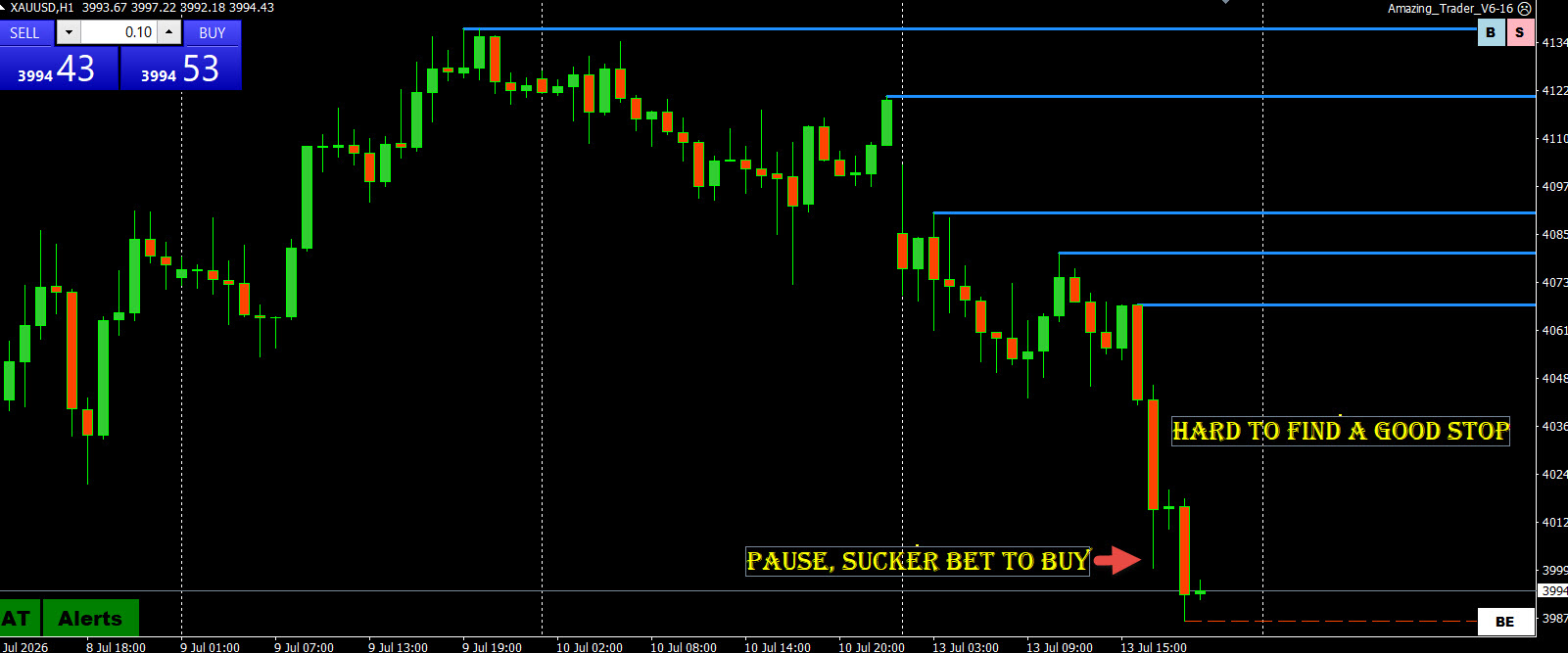
- Blue AT (Amazing Trader) lines dominate = trend down with momentum.
- The hard trade is to sell, especially the farther price gets from the closest blue AT line.
- Choices: sit it out, use a wide stop with reduced trade size to maintain % risk, or drill down to a shorter time frame (scroll below).
- The sucker bet is to try and pick the bottom until there is a reason to do so.
Why Trend Trading Works
One of the oldest sayings on Wall Street remains true:
“The trend is your friend.”
Markets move because buyers or sellers temporarily dominate supply and demand.
When institutions begin accumulating positions, trends can continue for days, weeks, or even months.
Trying to repeatedly fade those moves usually means fighting the very forces driving prices higher or lower.
Trend traders understand they do not need perfect entries.
They simply need to identify the prevailing direction and manage risk effectively.
Even average entries can become highly profitable when combined with proper trade management and disciplined execution. See also why we trade the episode, not the trend.
Price Action Always Comes First
Many traders become distracted by news headlines, social media opinions, or predictions about where prices “should” go.
Professional traders focus on something much simpler:
Price action.
Price tells the truth.
If buyers continue making higher highs and higher lows, the trend remains intact regardless of personal opinions.
Likewise, if sellers continue controlling the market, trying to buy simply because prices appear cheap rarely ends well.
Learning to trust price action instead of emotions is one of the biggest turning points in a trader’s development.
Trading With Probability Instead of Hope
Successful trading is never about certainty.
Every trade carries risk.
The objective is simply to place yourself on the side with the highest probability.
The hard trade often accomplishes exactly that.
Rather than trying to predict reversals, professional traders align themselves with existing momentum and allow probabilities to work over a series of trades.
This mindset removes much of the emotional pressure associated with trying to perfectly time market turning points.
Developing the Professional Trading Mindset
Professional traders think differently than beginners.
Instead of asking:
“Can I catch the exact top?”
They ask:
“What is the market telling me?”
Instead of searching for perfect entries, they focus on:
- Following the dominant trend
- Protecting trading capital
- Managing position size
- Accepting that no entry will ever be perfect
- Thinking in probabilities rather than certainty
Over time, these habits create consistency.
Consistency, not occasional spectacular trades, is what builds long-term trading success.
Hard Trade
Drill Down: A Way to Make the Hard Trade
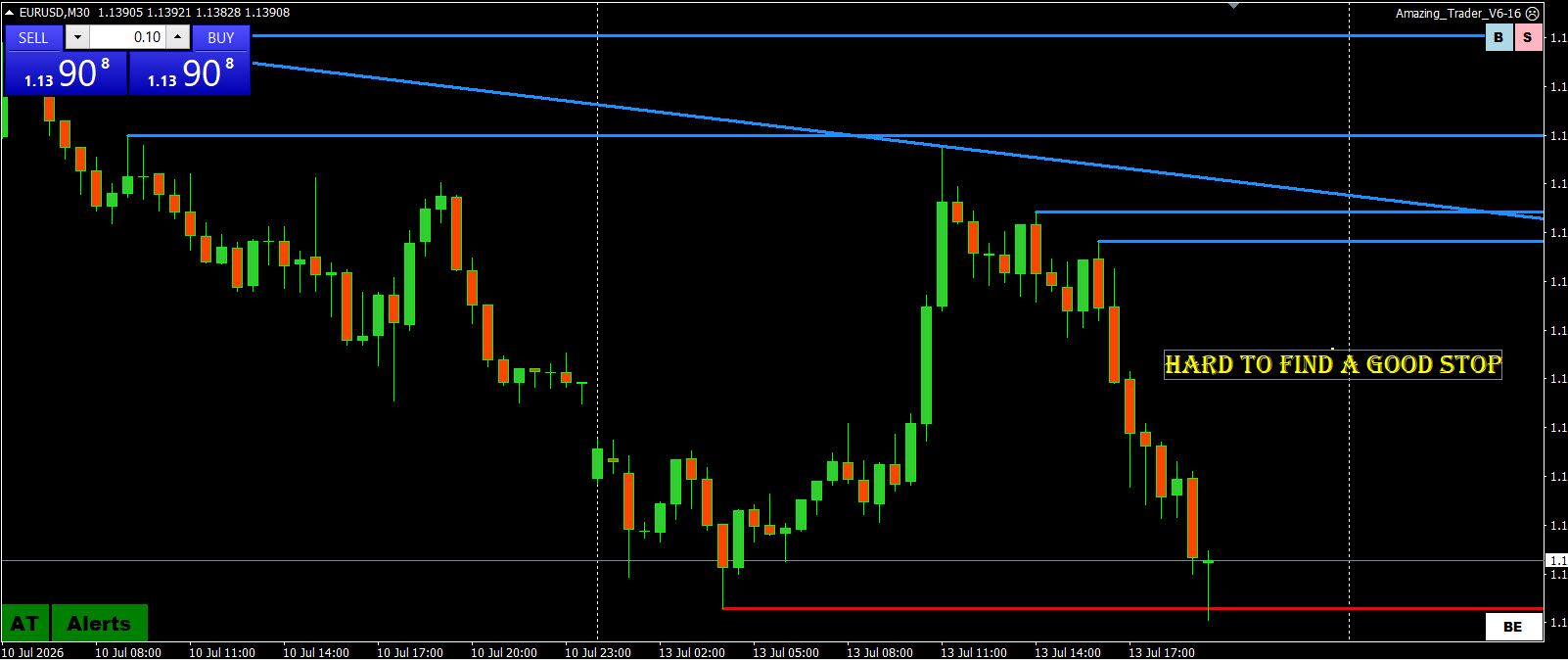
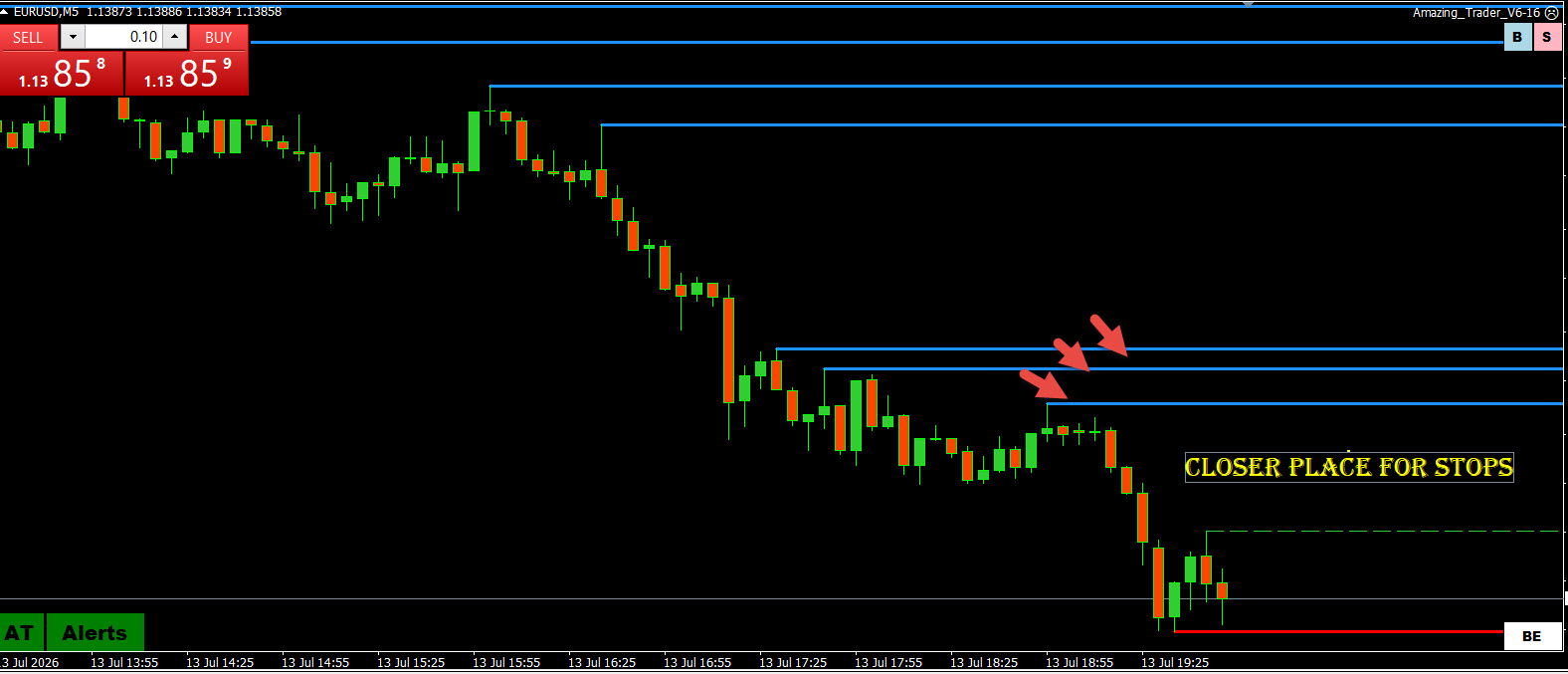
When a trend and momentum are clear but the only place for a stop is far away, drill down by going to a shorter time frame to find a risk/reward setup that you feel comfortable with.
Look at these Amazing Trader EURUSD charts, where falling blue lines indicate momentum to the downside. On the 30 minute chart, the stop is farther away. Drilling down to the 5 minute chart showed opportunities to trade with tighter stops.
Note: tighter stops may give a tighter risk/reward, while the wider stop gives the trade more time to work.
30 minute EURUSD chart
5 minute EURUSD chart (red arrows = potential stop levels)
Learn to Embrace the Hard Trade
The markets have a unique way of rewarding discipline while punishing emotion.
Easy trades usually feel comfortable because they satisfy our natural instincts. Hard trades feel uncomfortable because they require patience, discipline, and trust in the prevailing trend.
The next time you hesitate to buy a strong uptrend or sell a powerful downtrend, ask yourself a simple question:
Am I avoiding this trade because the market is wrong or because it feels uncomfortable?
More often than not, the answer lies in your emotions, not the charts.
Trading Blog
Daily Tips
About author