
A Trading Psychology Lesson Every Trader Needs to Learn
Trade Analyzer
One of the most valuable lessons I’ve learned over decades of trading is remarkably simple:
The market is not your enemy.
It doesn’t matter whether you trade stocks, futures, forex, commodities, cryptocurrencies, or options. Every trader eventually experiences a day when the market seems determined to prove them wrong. After a series of losing trades, it’s easy to believe the market is acting irrationally or even personally.
It isn’t.
The market has no emotions, no opinions, and certainly no agenda against you. It simply reflects the collective decisions of millions of buyers and sellers. Understanding that distinction can be the difference between becoming a disciplined trader and allowing emotions to take control.
A Lesson That Has Never Gone Out of Style
Years ago, I reviewed the trading recap of someone I had known for a long time. He was an experienced trader with solid technical skills, yet what I saw surprised me.
On a day when one market was trending aggressively, he tried repeatedly to pick the turning point instead of respecting the prevailing move. By the end of the session, he had accumulated 12 consecutive losing trades before finally walking away.
His problem wasn’t a lack of market knowledge.
It wasn’t a poor trading strategy.
It was a loss of discipline.
Instead of trading what the market was actually doing, he found himself arguing with price action and trying to prove the market wrong.
That experience reinforced a lesson every trader eventually learns.
Never make your trading a battle of wills with a mindless market.
Trade Analyzer
When Trading Becomes Personal
Have you ever had one of those days?
You enter a position with confidence.
The trade stops out.
You enter again.
Another loss.
Soon frustration begins replacing objectivity. Instead of reading the charts, you begin questioning every move. You become convinced the market is behaving irrationally and that a reversal must be just around the corner.
Without realizing it, you’ve stopped trading objectively.
You’ve started trading emotionally.
The Market Doesn’t Care About Your Opinion
Many traders unknowingly treat the market like an opponent.
They become angry after being stopped out.
Losers insist the market is wrong.
So most keep adding positions because they’re convinced price has gone too far.
The reality is much simpler.
The market isn’t trying to beat you.
It doesn’t even know you exist.
Markets are nothing more than price discovery mechanisms. Every move reflects the ongoing balance between supply and demand as institutions, hedge funds, central banks, corporations, algorithms, and retail traders execute their orders.
Price isn’t personal.
It’s simply information.
Trade Analyzer
Why Fighting the Trend Rarely Ends Well
One of the oldest sayings in trading remains one of the most accurate:
The trend is your friend.
When you’re trading in the direction of the prevailing trend, decisions become much easier. Risk management improves, emotions settle down, and pullbacks become opportunities rather than reasons to panic.
The problems begin when traders decide the trend has gone “too far” without a reason to make this claim.
Instead of respecting momentum, they begin trying to call the exact top or bottom.
They sell every rally in an uptrend.
They buy every dip in a downtrend.
Each stop-out strengthens their belief that the market has become irrational.
In reality, they’re simply fighting a trend that remains intact.
The Real Enemy Is Emotion
The market isn’t what destroys trading accounts.
Emotion is.
Frustration.
Ego.
Impatience.
The need to be right.
These emotions cause traders to abandon their trading plans, ignore technical signals, increase position sizes, and continue taking low-probability trades.
Ironically, while the trader becomes more emotional, the market remains completely unemotional.
It simply continues moving according to supply and demand.
Respect What Price Is Telling You
Successful traders understand they don’t have to predict every turning point.
They don’t need to catch the exact high or low.
They simply need to recognize what the market is communicating through price action.
When buyers remain in control, respect the uptrend.
Vice Versa -Sellers dominate, respect the downtrend.
The objective isn’t to outsmart the market.
It’s to align yourself with the highest-probability opportunities while managing risk.
Trade Analyzer
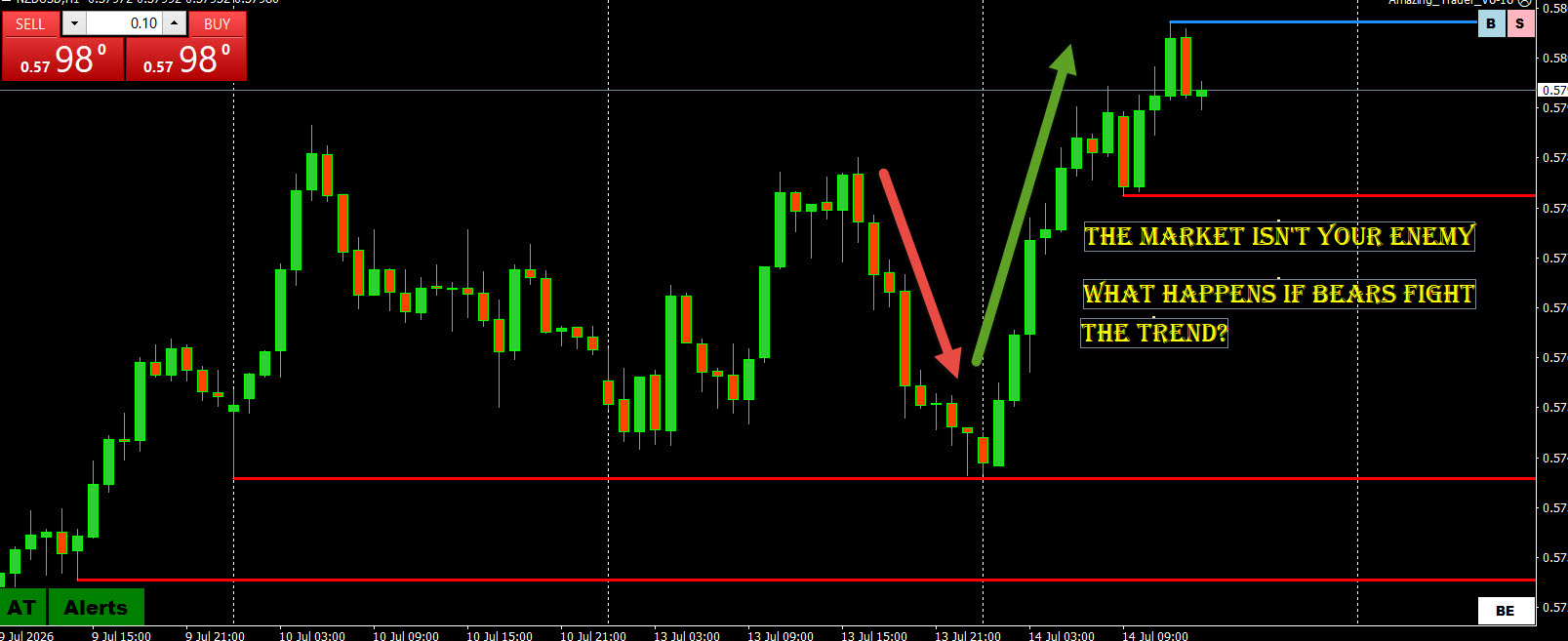
NZDUSD 1 Hour Chart
Imagine what can happen when trend turns and those trading the old (down) epsiode keep selling when a new episode turns up.
Know When to Walk Away
One of the most overlooked trading skills is recognizing when emotions are beginning to influence your decisions.
If you find yourself trading out of frustration, trying to recover losses immediately, or arguing with the charts, step away.
Take a break.
Review your trades later with a clear mind.
The market will be open tomorrow.
Protecting your emotional capital is every bit as important as protecting your financial capital.
Reality of trading
Every trader experiences losing streaks.
Every trader has difficult days.
The difference between successful traders and struggling traders isn’t that professionals avoid losses.
It’s that they never allow a losing trade to become a personal battle with the market.
The market isn’t your enemy.
It has no opinion.
Market has no emotion.
It simply reflects the collective decisions of participants around the world.
The next time you find yourself becoming frustrated after a series of losses, stop and ask yourself one question:
Am I trading what the market is doing, or am I trying to prove that I’m right?
The answer may save you from your next costly mistake.
Remember, the goal isn’t to beat the market.
The goal is to understand it, respect it, and trade with it.
Trade Analyzer
Daily Tips
Forex Blog
Test Plugin
About author

Add comment