
A Smarter Way to Navigate the Markets
Trend Trading
Successful trading isn’t just about predicting where the market will go next. It’s about recognizing what phase the market is currently in. One of the most valuable skills any trader can develop is the ability to identify the current market episode and trade in its direction while avoiding the temptation to hold on after the move has run its course.
Many traders focus solely on trends, but markets rarely move in a straight line. Instead, they unfold through a series of shorter-term episodes, each with its own beginning, middle, and end. Learning to recognize these episodes can dramatically improve your timing, risk management, and overall trading performance.
What Is a Market Episode?
A market episode is a distinct period during which price action follows a recognizable pattern. An episode may consist of:
- A short-term uptrend
- A short-term downtrend
- A period of sideways consolidation or range trading
Unlike major market trends that can last for weeks or months, trading episodes are temporary. They often develop over several hours or a few days before losing momentum and transitioning into a new phase.
Every market, whether forex, stocks, commodities, or cryptocurrencies, moves through a continuous sequence of episodes.
The Four Stages of a Trading Episode
Most market episodes share several common characteristics.
- The Beginning
Every episode starts with a meaningful high or low where buyers or sellers begin taking control. This often follows a breakout, reversal, or important technical level.
- Momentum Builds
As confidence grows, momentum accelerates.
In an upward episode, buyers continue stepping in on price dips.
In a downward episode, sellers emerge on rallies, preventing prices from recovering.
This is usually the portion of the move where trading with the prevailing direction offers the highest probability.
- Momentum Fades
No move lasts forever.
Eventually, buying or selling pressure begins to weaken. Stops become exhausted, profit-taking increases, or price encounters significant technical support or resistance.
The market starts showing signs that the current episode is losing strength.
-
A New Episode Begins
Once momentum fades, the market often enters consolidation or begins moving in the opposite direction.
This transition is where many traders get into trouble.
Don’t Keep Trading Yesterday’s Episode
One of the biggest mistakes traders make is continuing to trade an episode that has already ended.
Markets, particularly the forex market, can change direction quickly. Traders often become emotionally attached to the previous move and fail to recognize when conditions have changed.
Common examples include:
- Continuing to sell rallies after the market has already formed a significant bottom.
- Continuing to buy dips after an established uptrend has topped out.
- Expecting yesterday’s trend to continue despite clear signs of reversal.
The longer traders cling to an outdated market view, the greater the risk of finding themselves on the wrong side of the next move.
Trend Trading
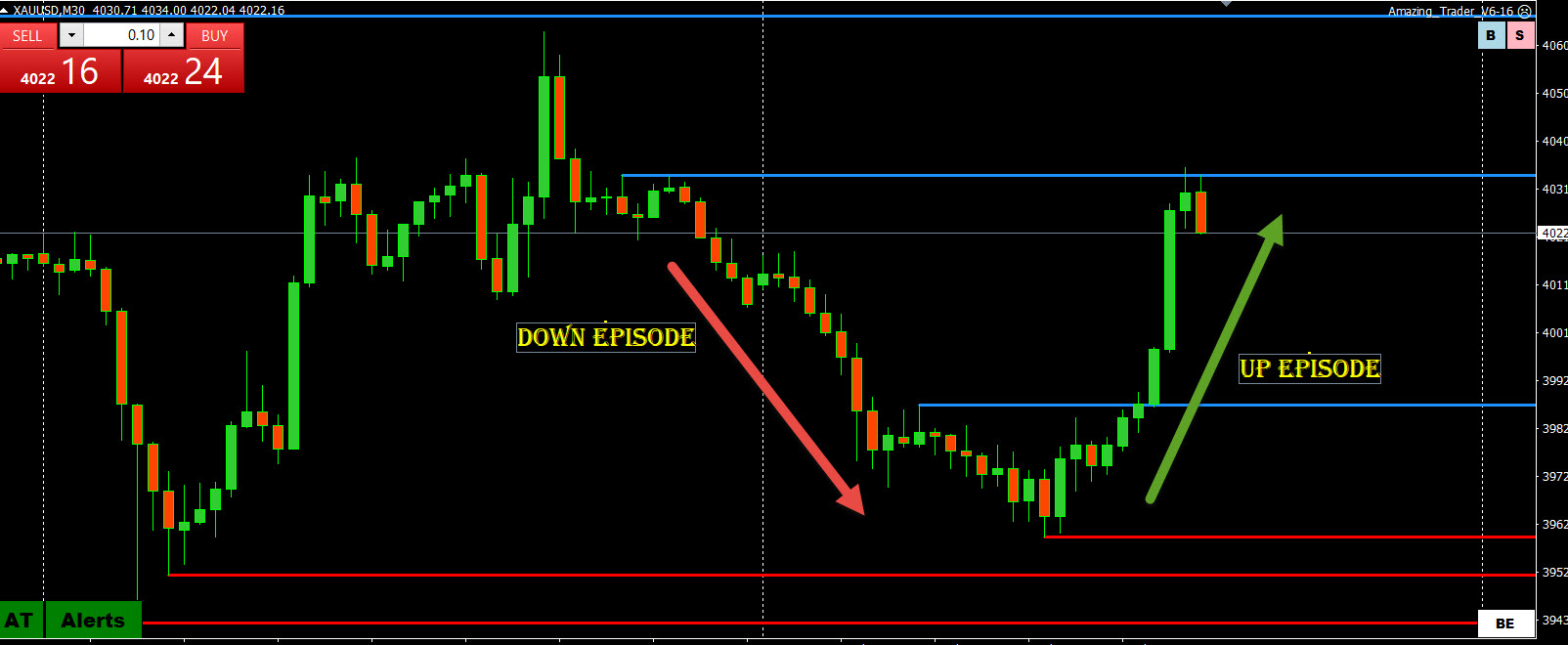
Amazing Trader XAUUSD (GOLD) 30 Minute chart
Break of blue line indicated end of down episode and change in direction (up episode)
Why Episodes Matter More Than Predictions
Many traders spend enormous amounts of time trying to predict what the market will do next.
Professional traders often approach the market differently.
Rather than predicting, they identify the current episode and trade what is actually happening now..
Trading in the direction of the active episode puts probabilities in your favor because you are aligning yourself with current market momentum instead of fighting it.
The goal is not to forecast every market turn.
The goal is to recognize when the current episode is healthy, participate while momentum exists, and exit before conditions change.
Trade With the Episode But Don’t Overstay Your Welcome
One of the keys to consistent trading is knowing when an episode is nearing its end.
As momentum fades, the probability of continued gains decreases while the risk of reversal increases.
Successful traders understand that every episode eventually ends.
Instead of hoping the move continues indefinitely, they recognize changing market conditions and adapt accordingly.
The market rewards flexibility, not stubbornness.
Is the Episode Following the Larger Trend?
Not every episode carries the same probability.
One of the first questions traders should ask is whether the current move is:
- Trading in the direction of the larger trend
- A countertrend retracement
Episodes that align with the higher-timeframe trend generally have greater staying power and offer higher-probability opportunities.
Countertrend episodes can still produce profitable trades, but they typically carry more risk and often end much sooner.
Always consider the bigger picture before committing to a short-term trade.
Session Timing Matters
Timing also plays an important role.
Short-term retracement episodes that develop early during the European or U.S. trading sessions frequently reverse as institutional traders enter the market and volume increases.
For this reason, traders should be cautious about assuming that every early-session move represents the beginning of a sustained trend.
Watching how price reacts during the major trading sessions can provide valuable clues about whether the current episode is likely to continue or quickly fade.
To sum up, trading success often comes from understanding where the market is now, not where you hope it will be later or where it has been.
Every market moves through a series of episodes, each with its own beginning, momentum phase, and conclusion. Recognizing these transitions allows traders to stay aligned with current price action while avoiding the costly mistake of trading an episode that has already ended.
The objective is simple:
- Identify the current episode.
- Trade with the prevailing momentum.
- Monitor for signs of exhaustion.
- Exit when the episode changes.
- Stay flexible enough to adapt to the next opportunity.
Master the concept of trading episodes, and you’ll stop chasing yesterday’s market and start trading the one that’s unfolding in front of you.
Addendum: I personally use the Amazing Trader charting algo and the patterns its lines form to identify episodes. As there is no one size fits all strategy, each trader needs to use his/her tools at hand to identify when episodes begiun and when the end and reverse direction.
Trend Trading
Daily Tips
Trading Blog
Test Plugin
About author

Add comment